
What CEOs Can Do to Rethink Their Talent Strategy

According to a recent survey, CEOs cited attracting and retaining talent as their top concern. 93% of CEOs report they either recognize the need to change or have taken steps to modify their strategies for attracting and retaining talent. While CEOs are aware of global challenges inherent to the changing talent landscape, they often feel unsure about how to approach these obstacles.
For all their uncertainty, 61% of CEOs admit they have yet to address their talent concerns by implementing an effective talent management strategy. Building a workforce equipped to tackle the challenges of today and tomorrow requires leadership to fundamentally rethink talent strategy. In the end, an organization’s ability to drive results rests in the power of its people. But if those people feel unmotivated to stay, fail to engage with their work, or just don’t fit the position, the ship is sunk. So, what’s the solution?
3 Tips for How to Select & Engage Your Talent
Tip #1: Have a talent management strategy in place. This might sound complex, but it doesn’t have to be. Adopting a talent management strategy simply means planning and envisioning talent needs in a way that makes them top priorities rather than secondary, reactionary concerns. Talent management takes an active stance towards understanding where the organization is headed, what the needed roles are to meet business goals, and who the right people are to fit these positions. Talent management strategies also consider how the organization can nurture employees to perform their roles successfully. They create conditions where companies can react with speed, flexibility, and a set protocol when talent needs arise. In the end, this allows for reduced turnover, increased engagement, and greater consistency.
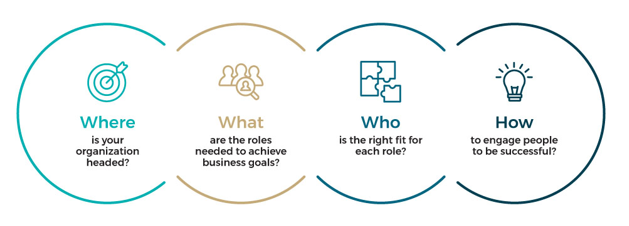
When mapping out how to design a workforce, finding answers to these questions gets to the root of the challenge. Answering these who, what, where, and how questions will force an organization to identify solutions to those inevitable talent needs challenges and can lessen the impact of disruptions when they occur.
Knowing what your organization requires to meet its goals is one thing; the real challenge is finding the right talent to meet those goals. Matching the right person to a role where they can find success requires more than just asking the right questions – it requires the right information, which leads us to our second tip.
Tip #2: Use personalized candidate data to make talent decisions. Alright, so you figured out the specific requirements for a job and are now looking for someone to fit the mold. But if you want that ideal candidate you created on paper to do any good for your organization, they need to be translated into human form.
That’s where Job Fit comes in.
Job Fit predicts a person’s ability to find success in a role. How? Assessments can measure candidates’ personal characteristics against a set of characteristics required to perform a job successfully. Comparing the ideal standard of the job to the candidate’s assessment results determines the percentage of Job Fit. The closer the result to the target, the better the fit.
After collecting data on how a person thinks and works, organizations can use this information to match people to the right job opportunities at every point of the employee life cycle – from when they enter a new organization to when they move teams or receive promotions. Understanding this information up front helps leaders make smarter hiring and selection decisions and helps them engage their workforce to perform successfully.
Tip #3: Consider PXT Select™ as an option for measuring Job Fit. As an assessment with a history of helping 42,000 organizations across 90 countries over the past 20+ years, PXT Select has a track record for success Those 20+ years of serving organizational needs also includes decades of rigorous research, testing, and development in refining PXT Select into the solution it is today.
As we mentioned earlier, PXT Select uses candidate data to match an individual’s results against requirements of a specific position. If the assessment identifies a candidate as a highly independent worker and that’s what the applicable position calls for – congratulations – you’ve identified just one trait where the candidate proved to be a good match. In total, PXT Select measures 20 different characteristics that assess an individual’s cognitive ability, behavioral skills, and motivational interests. That’s the depth of information required to truly measure Job Fit and predict future success in a role.
A Simple Solution for a Complex Challenge
In the end, PXT Select addresses talent management challenges in a simple way – by proactively identifying your organization’s needs and matching people to roles where they can perform successfully and drive results. That’s easy enough to understand; but, to find the candidate information we need to make informed decisions, we can’t rely on resumes, references, and prior experiences alone. We need a tool that accounts for the complexity of a human being – something that goes beneath the surface and collects objective information.
To make informed talent decisions and match actual, complex people to the needs of your organization and to fully develop these individuals, you need objective information gathered through the lens of Job Fit.
The PXT Select isn’t the only tool in our toolbox. We have a suite of assessments for Emotional Intelligence, Core Competencies, Customer Service, Everything DiSC, and 360s as well as culture consulting, and a host of other training programs.
Check us out at www.GreatLakesProfiles.com. We’re here to help, reach out to us at Jim@GreatLakesProfiles.com or call me at (248) 388-0697.